Choosing the right golf cart battery in 2026 is not simply a contest between lead-acid and lithium. The answer depends on distance, terrain, charging habits, climate, payload, and budget. A cart climbing wet hills needs different support from one used for short trips on a flat resort path.
Battery consultant Bob Galyen has often emphasized a practical principle: “There is no single battery chemistry that wins every application.” That view matters here. Lithium iron phosphate batteries usually provide lower weight, steadier voltage, faster charging, and longer service life. A lithium pack can also leave more room under the seat. Lead-acid batteries remain affordable, familiar, and widely supported. However, they require watering, ventilation, and careful charging. They are not maintenance-free.
So, what kind of battery is best for golf carts? For frequent driving and long-term ownership, lithium iron phosphate is often the stronger choice. For occasional use and a tight initial budget, deep-cycle lead-acid may still make sense. “Best” is conditional.
A useful real-world check is simple. Measure your weekly driving distance. Note hills, passenger weight, and winter temperatures. Then compare the battery’s usable capacity, warranty, charger compatibility, installation requirements, and recycling support. Do not judge by voltage alone. That shortcut causes trouble.
This guide examines the practical trade-offs for 2026. It also questions popular claims, because lithium is not automatically perfect. Upfront cost can be uncomfortable. Replacement parts may vary by brand. Reliable performance still depends on correct installation and charging.
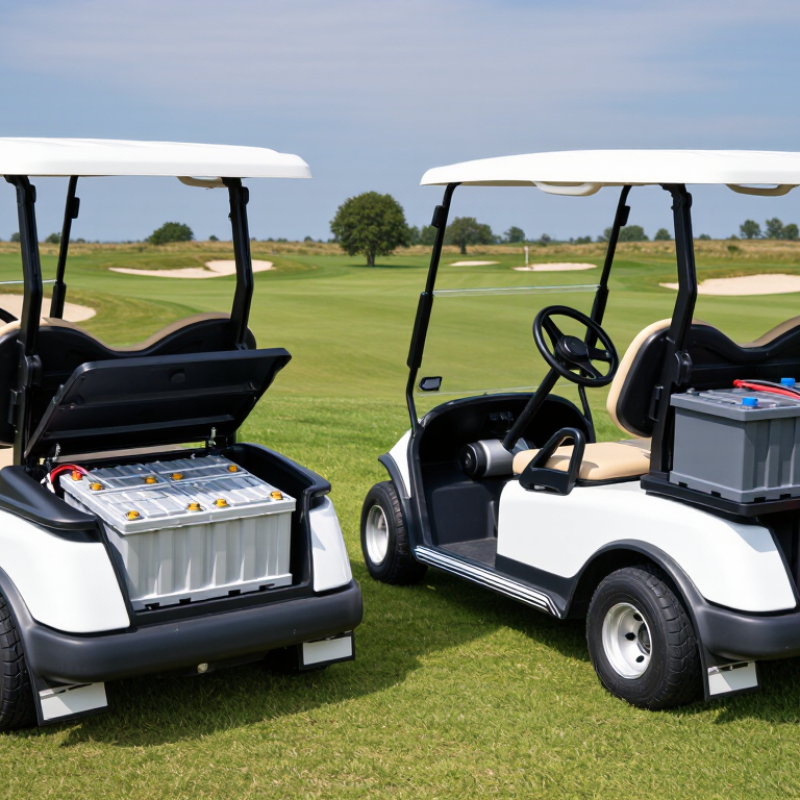
In 2026, golf cart owners can choose flooded lead-acid, AGM, gel, and lithium batteries. Each type serves a different driving pattern. Flooded lead-acid batteries remain common because they cost less and tolerate basic operating conditions. However, they need regular water checks, clean terminals, and proper ventilation. A neglected battery can lose capacity quickly. AGM batteries use sealed construction and resist vibration better, making them practical for uneven paths. Gel batteries also reduce spill concerns, but they require a charger with the correct charging profile.
Lithium iron phosphate batteries are now a major option for modern golf carts. They weigh much less than lead-acid packs and usually deliver steadier voltage during acceleration. Their built-in battery management system helps control overcharging, overheating, and excessive discharge. Lithium packs still need careful installation. The charger, cables, voltage, and motor controller must match the battery system. Cold weather can also reduce charging performance. Not every lightweight pack is automatically better.
Some 2026 models may use newer lithium chemistries or sodium-ion designs, but availability and service support vary by region. Check the technical datasheet, cycle rating, usable amp-hours, and warranty conditions. In practical testing, range depends on hills, passenger weight, tire pressure, and driving speed. My earlier assumption was simple: lighter meant best. Real use proved otherwise. A well-maintained lead-acid pack can suit short trips, while frequent, longer driving may justify lithium’s higher purchase price.
Battery choice should begin with duty, not price. A cart carrying two adults on level paths needs less energy than one climbing slopes with tools. Measure usable voltage stability, amp-hour capacity, charging time, and weight. A battery showing high capacity on paper may perform poorly after repeated deep discharges. Real-world testing matters.
The U.S. Department of Energy’s 2024 Battery Technology Report identifies cycle life, thermal control, and charging efficiency as key performance indicators. Its data also shows that operating temperature and charging habits strongly affect battery aging. NREL’s Energy Storage Technology and Cost Characterization Report estimates lithium-ion systems around 3,000 cycles under controlled conditions. Lead-acid systems usually deliver fewer cycles, often about 500 to 1,000, depending on depth of discharge and maintenance. These figures are useful, but golf-cart results can differ.
Check the warranty conditions carefully. Some warranties require specific chargers, storage temperatures, or minimum maintenance records. Compare energy delivered per cycle, not only the purchase price. A simple calculation helps: battery cost divided by expected usable cycles. Also inspect voltage drop during a hill climb. That small test can reveal more than a showroom specification.
I would not trust cycle-life claims alone. Weather, passenger weight, tire pressure, and charging delays change the outcome. My own comparison would record range, recharge time, and voltage after every ten trips. Imperfect data is still better than confident guessing.
What Kind of Battery Is Best for Golf Carts in 2026?
Lithium-ion and lead-acid batteries serve different golf cart owners. Lithium-ion packs usually weigh much less, often reducing cart weight by over 100 pounds. That difference can improve acceleration, hill climbing, and tire wear. They also deliver steadier voltage, so the cart may feel stronger near the end of a ride. Charging is generally faster, and usable capacity is often higher. However, the purchase price remains considerably higher. The charger and battery management system must also be compatible.
Lead-acid batteries remain practical for buyers watching the initial budget. They are widely understood, simple to replace, and suitable for occasional neighborhood driving. Flooded versions need regular water checks, clean terminals, and careful charging. They are heavy. Very heavy. A cart carrying six large batteries can feel slower on grass or steep paths. AGM lead-acid batteries reduce maintenance, but they still bring substantial weight and usually offer fewer deep cycles than lithium-ion options.
Daily use changes the calculation. A fleet cart covering several miles each day may benefit from lithium-ion’s longer service life and reduced maintenance time. A privately used cart that travels short distances may make lead-acid ownership easier to justify. Storage conditions matter, too. Freezing temperatures can reduce performance, while extreme heat can shorten battery life. One common mistake is comparing only purchase prices. I used to view that as the clearest measure, but replacement intervals, charging losses, and downtime can alter the real cost. Check the cart’s voltage, charger requirements, payload, terrain, and expected yearly use before choosing.
| Comparison Dimension | Lithium-Ion Batteries | Lead-Acid Batteries | Typical Advantage |
|---|---|---|---|
| Common Golf-Cart System Voltage | Available in common 36-volt, 48-volt, and 72-volt configurations. A battery-management system is normally integrated into the pack. | Commonly built from multiple 6-volt, 8-volt, or 12-volt deep-cycle batteries connected in series. | Depends on the cart |
| Typical Usable Depth of Discharge | Approximately 80% to 90% of rated capacity is commonly usable without materially shortening service life. | Approximately 50% is generally recommended for routine use to limit sulfation and capacity loss. | Lithium-ion |
| Round-Trip Charging Efficiency | Typically about 90% to 98%, depending on cell chemistry, charger, temperature, and battery-management settings. | Typically about 70% to 85%; more energy is lost as heat and during the charging process. | Lithium-ion |
| Typical Cycle Life | Approximately 2,000 to 5,000 full-equivalent cycles for quality lithium iron phosphate systems under suitable operating conditions. | Approximately 500 to 1,000 cycles when regularly maintained and discharged within recommended limits. | Lithium-ion |
| Expected Service Life | Often about 8 to 15 years, depending on usage, storage temperature, charging practices, and cycle count. | Often about 3 to 6 years in regular golf-cart service, with heavy use potentially reducing life. | Lithium-ion |
| Energy Density | Approximately 90 to 160 Wh/kg, depending on the lithium chemistry and pack design. | Approximately 30 to 50 Wh/kg. | Lithium-ion |
| Typical 48-Volt Pack Weight | Approximately 100 to 180 lb (45 to 82 kg), depending on capacity and enclosure design. | Approximately 250 to 350 lb (113 to 159 kg) for a comparable deep-cycle pack. | Lithium-ion |
| Vehicle Performance | Lower weight can improve acceleration, hill climbing, handling, and available payload. Voltage usually remains more stable during discharge. | Higher pack weight reduces payload capacity. Voltage tends to decline more noticeably as the battery discharges. | Lithium-ion |
| Charging Time | Commonly about 3 to 6 hours, depending on pack size, charger output, temperature, and state of charge. | Commonly about 6 to 10 hours, with the final absorption stage taking substantial time. | Lithium-ion |
| Partial Charging | Generally well suited to frequent partial charging when the approved charger and battery-management system are used. | Frequent shallow charging can contribute to sulfation if the battery is not periodically fully charged. | Lithium-ion |
| Maintenance Requirements | Usually low maintenance. Periodic inspection of terminals, cables, mounting hardware, and battery-management alerts is still required. | Requires regular terminal inspection, cleaning, cable checks, and, for flooded batteries, distilled-water replacement. | Lithium-ion |
| Watering Requirement | No routine watering is required. | Flooded types require periodic watering with distilled water. Sealed lead-acid types do not require watering but still have lead-acid charging characteristics. | Lithium-ion |
| Cold-Weather Charging | Many lithium packs should not be charged below 0°C (32°F) unless they include low-temperature charge protection or heating. | Can generally be charged below freezing, although charging is slower and available capacity decreases in cold conditions. | Lead-acid |
| High-Temperature Operation | Performs efficiently, but sustained high temperatures can accelerate cell aging. Manufacturer temperature limits must be followed. | High temperatures accelerate water loss, corrosion, and plate degradation, particularly in flooded batteries. | Lithium-ion |
| Upfront Purchase Cost | Usually higher, often around two to four times the initial cost of a comparable lead-acid replacement pack. | Usually lower and widely available in standard golf-cart sizes. | Lead-acid |
| Long-Term Cost of Ownership | Higher initial cost can be offset by longer life, lower maintenance, higher efficiency, and fewer replacement cycles. | Lower initial cost, but replacement batteries, maintenance, charging losses, and disposal can increase lifetime cost. | Often lithium-ion |
| Safety and Protection | Requires a properly designed battery-management system, suitable charger, secure installation, and protection against overcharge, over-discharge, and excessive temperature. | Well-established technology, but flooded batteries can release hydrogen during charging and contain corrosive electrolyte. | Application-dependent |
| Environmental Considerations | Longer service life and higher efficiency can reduce replacement frequency and operating losses. Recycling pathways vary by region and chemistry. | Lead-acid batteries have a mature recycling system, but lead and sulfuric acid require controlled handling and recycling. | Depends on lifecycle |
| Best Fit for Frequent Use | Well suited to daily use, fleet operations, frequent charging, long distances, and applications where low weight matters. | Suitable for occasional or moderate use where the lowest initial purchase price is the main priority. | Lithium-ion |
| Best Overall Choice in 2026 | Often the stronger long-term option for owners who prioritize performance, low maintenance, usable capacity, and service life. | Still practical for budget-conscious buyers, short-distance use, existing compatible chargers, and applications where cold-weather charging is important. | Lithium-ion for most heavy-use cases |
| Data note: Values are representative industry ranges rather than guarantees. Actual performance depends on battery chemistry, capacity, pack design, charger compatibility, ambient temperature, driving conditions, maintenance, and the golf cart’s electrical system. Always follow the battery and vehicle manufacturer’s installation, charging, and safety requirements. | |||
What Kind of Battery Is Best for Golf Carts in 2026?
Key Factors for Choosing the Best Golf Cart Battery
Choosing the best golf cart battery starts with the cart, not the sales label. Check its voltage, tray size, cable condition, and charger compatibility. A six-battery system needs a different replacement plan than a four-battery system. Measure twice. A battery can fit physically but still fail electrically. Lead-acid batteries cost less upfront and remain easy to service. They need regular watering, clean terminals, and good ventilation. AGM batteries reduce maintenance, but their higher price may not suit every budget.
Lithium iron phosphate batteries are lighter and usually deliver steadier power near the end of a round. They can also provide more usable energy and many charge cycles. However, the battery management system and charger must match the pack. Cold storage, heat, and deep discharge still matter. Do not judge capacity by amp-hours alone. Compare usable watt-hours, expected cycle life, warranty terms, and charging time. A heavier lead-acid set may make the cart feel slower on hills. I noticed this most when carrying two passengers.
Real-world use should guide the decision. Short neighborhood trips may favor a cheaper, serviceable battery. Frequent hills, long routes, or commercial use may justify a lighter lithium setup. Inspect terminals every few weeks, record charging behavior, and watch for swelling, leaks, unusual heat, or rapid voltage loss. If the cart struggles after a full charge, test the pack under load instead of guessing. I once assumed charging overnight fixed everything. That assumption was wrong. Ask a qualified technician to verify wiring and charger settings before installation.
Key factors include cycle life, usable depth of discharge, charging efficiency, maintenance, and weight. The chart uses representative midpoint values from commonly published specifications for each battery chemistry; actual performance varies with temperature, charging practices, load, and maintenance.
How to read the chart: Lithium iron phosphate batteries generally provide the longest service life and highest usable capacity, while lead-acid batteries typically have a lower purchase cost and simpler replacement options. Flooded lead-acid batteries require regular water checks, whereas AGM and lithium batteries are generally maintenance-free.
What Kind of Battery Is Best for Golf Carts in 2026?
Safe battery performance begins before the first drive. In workshop practice, battery choice depends on weight, budget, charging habits, and the cart’s electrical system. Lithium batteries are lighter and usually require less routine care. Lead-acid batteries remain practical for buyers who accept regular watering and heavier weight. Neither option is automatically best.
Turn off the cart before installation. Remove jewelry and wear eye protection and acid-resistant gloves. Place the cart on a level surface with the parking brake engaged. Check the battery tray for corrosion, cracks, or loose hardware. Clean and dry the area first. Always match voltage, capacity, terminals, and charger specifications. Reversing polarity can damage the controller. Tighten connections firmly, but do not crush the terminals. A loose cable may become hot under load.
Charging needs ventilation. Keep sparks, flames, and cigarettes away from lead-acid batteries. Use the correct charger, and inspect cables before every cycle. Stop charging if you notice swelling, leaking, unusual heat, or a sharp odor. Lithium systems also need a compatible charger and battery-management system. Do not bypass protective controls. For lead-acid batteries, check electrolyte levels after charging, using distilled water only when required. Wipe corrosion with an approved method, not bare hands. My maintenance checklist is not perfect, so I record dates and voltage readings. That simple habit often reveals declining capacity early. Damage still demands professional inspection.
Compare usable energy, voltage stability, weight, charging time, and expected cycles. Amp-hours alone can mislead. Test the cart on a hill. Record voltage before and during the climb.
Lead-acid batteries cost less and remain widely serviceable. They need watering, clean terminals, and ventilation. Lithium iron phosphate batteries weigh less and provide steadier power. Neither option wins for every cart.
Hills, heavy passengers, tools, and long routes increase energy demand. Frequent deep discharges can shorten battery life. Short, level trips are gentler. Tire pressure also matters.
Lithium systems may reach about 3,000 controlled cycles. Lead-acid systems often provide about 500 to 1,000 cycles. Actual results vary with temperature, discharge depth, and maintenance. Published figures are not promises.
Divide the battery cost by its expected usable cycles. Then compare energy delivered during each cycle. Include charger costs, maintenance, and possible installation work. Cheap upfront pricing can become expensive later.
Turn off the cart and engage the parking brake. Wear eye protection and acid-resistant gloves. Remove jewelry before handling cables. Match voltage, terminals, capacity, and charger specifications. Reverse polarity can damage electrical components.
Use a compatible charger and inspect cables before charging. Keep charging areas ventilated. Keep flames, cigarettes, and sparks away from lead-acid batteries. Use distilled water only when required. Do not bypass lithium protection controls.
Watch for swelling, leaks, unusual heat, sharp odors, and rapid voltage loss. A cart may struggle after a full charge. Test the battery under load before replacing it. My records are imperfect. Still, dates and voltage readings reveal patterns.
Choosing what kind of battery is best for golf carts in 2026 depends on driving habits, budget, maintenance preferences, and the cart’s electrical requirements. Available options include traditional flooded lead-acid, sealed lead-acid, and lithium-ion batteries. Lead-acid batteries remain a practical choice for lower upfront costs, while lithium-ion batteries generally offer lighter weight, faster charging, longer cycle life, and more consistent power. To compare performance and lifespan, consider usable capacity, driving range, charging time, energy efficiency, expected cycles, operating conditions, and warranty coverage.
The best battery should match the cart’s voltage, available space, weight limits, and daily workload. Installation must follow the manufacturer’s specifications, including correct cable connections, secure mounting, and suitable charger compatibility. Safe charging requires proper ventilation for batteries that may release gas, protection from heat and moisture, and avoidance of damaged equipment. Regular maintenance, such as checking terminals, cleaning connections, monitoring charge levels, and inspecting for swelling or corrosion, can improve reliability and extend battery life.

Golvaris Car